
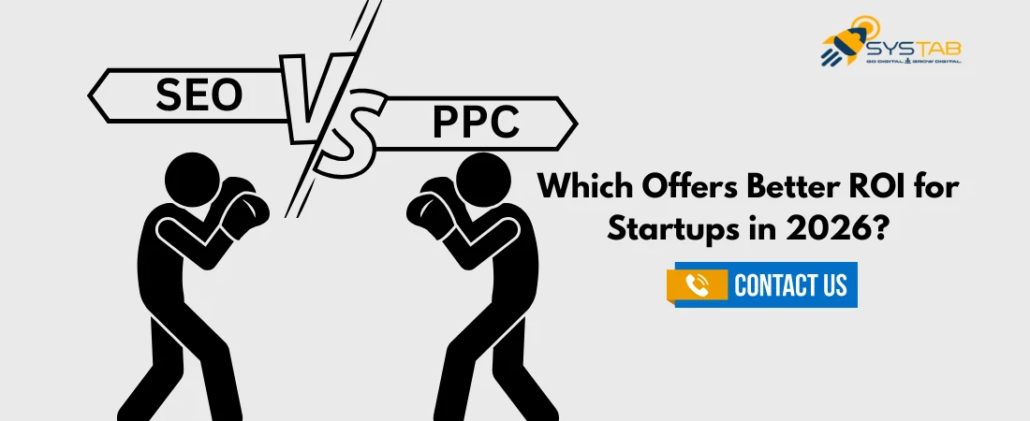
SEO vs. PPC: Which Offers Better ROI for Startups in 2026?
Starting a business is thrilling, isn’t it? You’ve got the big idea, the passion, and probably a limited budget. Now comes the million-dollar question. How do you get noticed online?
When it comes to digital marketing, two giants always face off: SEO (Search Engine Optimization) and PPC (Pay-Per-Click) advertising. Both promise visibility, traffic, and sales, but they go about it in vastly different ways. For a startup in 2026, understanding which one (or both!) offers the better Return on Investment (ROI) isn’t just smart – it’s crucial for survival and growth.
Let’s break down this battle, look at some real-world examples from SysTab’s clientele, and help you decide your winning strategy.
The Contenders: A Quick Intro SEO vs PPC
1. SEO: The Marathon Runner Imagine SEO as planting a tree. You choose the right spot (keywords), nurture it (content, technical optimization), and over time, it grows into a mighty oak, providing shade (traffic) and fruit (conversions) for years to come, practically for free once it’s established.
- How it works: SEO is all about optimizing your website and its content to rank higher organically (naturally) in search engine results (like Google, Bing, or even generative AI tools). This involves technical tweaks, amazing content, building authority, and much more.
- Cost: “Free” traffic, but it requires upfront investment in strategy, content creation, technical fixes, and ongoing optimization (or paying an agency like SysTab to do it for you!).
- Timeframe: Results are typically slower, taking months to truly manifest, but they are sustainable.
2. PPC: The Sprinter PPC is like renting a billboard. You pay for immediate visibility, and as long as you’re paying, your message is front and center. Stop paying, and the billboard goes blank.
- How it works: You bid on keywords, and when someone searches for those terms, your ad appears at the top or bottom of the search results page. You pay a fee every time someone clicks your ad.
- Cost: You pay for every click, and bids can vary wildly depending on competition. Requires a direct ad budget.
- Timeframe: Instant results! Your ads can go live within minutes and start driving traffic immediately.
Why the Debate Matters More Than Ever for Startups in 2026
The digital landscape in 2026 is a fascinating place. We’re seeing:
- Increased Competition: More businesses than ever are online, all vying for attention.
- AI’s Influence: Generative AI is changing how users search and how results are presented. Optimizing for AI-powered summaries (think Google Gemini or ChatGPT integrations) is becoming a new frontier.
- Smarter Consumers: Users are savvier, often skipping ads if organic results provide the answer they need quickly.
- Data, Data, Data: The ability to track and analyze every penny spent and every click gained is more sophisticated, making ROI calculations more precise.
For a startup with limited resources, every dollar (or rupee!) must work overtime. This is where understanding the nuanced ROI of SEO vs. PPC becomes critical.
The Case for SEO: Long-Term Growth and Brand Authority
Think about your favorite coffee shop. You didn’t find it through an ad; you probably heard about it, saw it pop up organically on Google Maps when you searched “best coffee near me,” or a friend recommended it. That’s the power of organic discovery, driven by SEO.
Advantages of SEO for Startups:
- Sustainable, “Free” Traffic: Once you rank, you continue to receive traffic without directly paying per click. This compounds over time, making it incredibly cost-effective in the long run.
- Higher Trust and Credibility: Users generally trust organic results more than paid ads. Appearing naturally at the top of search results builds immense brand authority and credibility. A study by Infront Webworks showed that 70-80% of users ignore paid ads, focusing solely on organic results.
- Better User Experience: SEO encourages you to create high-quality, relevant content that genuinely answers user queries. This leads to a better on-site experience, lower bounce rates, and higher engagement.
- Local Dominance: For startups targeting a specific geographic area (like Kolkata!), Local SEO is a game-changer. Optimizing your Google Business Profile (GBP), local citations, and geo-targeted keywords can put you directly in front of local customers actively looking for your services.
- Adapting to AI Search: As AI integrates more into search, strong foundational SEO (semantic understanding, clear content structure, entity optimization) is crucial for your content to be pulled into AI-generated summaries and answers.
- Brand Building: Consistent visibility in organic search helps embed your brand into the minds of your target audience, making you a recognized authority in your niche.
Challenges of SEO for Startups:
- Time Investment: SEO is a marathon, not a sprint. It takes time for search engines to crawl, index, and rank your content. Startups often need immediate results.
- Constant Evolution: Search engine algorithms are always changing. What works today might need tweaking tomorrow, requiring ongoing effort and adaptation.
- High Competition: For highly lucrative keywords, breaking into the top rankings can be extremely challenging, especially without a strong domain authority.
- No Guarantees: While best practices improve your chances, no one can guarantee specific rankings due to the dynamic nature of search engines.
Real-World Example: SysTab & Cyborg Service (SEO Success)
SysTab partnered with Cyborg Service, a burgeoning Home appliance repair service in Kolkata. Cyborg Service faced fierce competition from established players but had a distinct advantage: a commitment to exceptional, personalized service.
SysTab’s SEO strategy for Cyborg Service focused on:
- Hyper-Local SEO: Optimizing for terms like “TV repair near me Kolkata,” “LED TV screen replacement Salt Lake,” and “ac repairing services New Town.” This involved aggressive Google Business Profile optimization, local citation building, and geo-targeted content.
- Content Authority: Creating helpful guides and blog posts like “Common Smart TV Problems and How to Fix Them” or “Choosing the Right Ac Repair Technician in 2026.” These articles established Cyborg Service as an expert resource.
- Technical SEO: Ensuring Cyborg Service’s website was lightning-fast, mobile-friendly, and had proper schema markup to stand out in local search and AI-powered answers.
The Result: Within 8-10 months, Cyborg Service saw a significant increase in organic traffic (over 150%) for their key local terms. More importantly, their local organic leads increased by 80%, demonstrating a powerful long-term ROI. Customers found them naturally through search, trusted their organic presence, and converted into loyal clients, all without paying a click fee.
The Case for PPC: Immediate Impact and Targeted Precision
Sometimes, you don’t have months to wait. You need customers now. That’s where PPC shines. It’s the equivalent of putting up a “Grand Opening Sale!” sign and getting people through the door immediately.
Advantages of PPC for Startups:
- Instant Visibility: Your ads can appear at the very top of search results within minutes of launching a campaign. This is invaluable for new businesses needing to generate immediate leads or sales.
- Hyper-Targeting: PPC allows incredible precision. You can target users by location, demographics, interests, devices, time of day, and even specific keywords they use. This ensures your ad budget is spent on the most relevant audience.
- Measurable ROI: PPC platforms provide extensive analytics, allowing you to track every impression, click, conversion, and the exact cost per conversion. This makes it easier to optimize campaigns and calculate your exact ROI.
- Flexibility and Control: You have complete control over your budget. You can start, pause, or stop campaigns at any time, adjust bids, and test different ad creatives instantly. This agility is perfect for startups needing to pivot quickly.
- Brand Awareness (Even Without Clicks): Even if users don’t click your ad, seeing your brand name repeatedly at the top of search results can build brand recognition over time.
- Quick A/B Testing: PPC is excellent for testing different messaging, offers, and landing pages to see what resonates best with your audience before investing heavily in content creation for SEO.
Challenges of PPC for Startups:
- Cost: As soon as you stop paying, your traffic stops. High-competition keywords can be very expensive, quickly draining a startup’s limited budget.
- Ad Fatigue: Users can become blind to ads, especially if they see the same message repeatedly.
- Requires Expertise: While easy to start, running profitable PPC campaigns requires significant expertise in keyword research, bidding strategies, ad copy, and landing page optimization.
- Ad Blocker Usage: A small percentage of users employ ad blockers, meaning they won’t see your ads at all.
- Potential for Low Quality Leads: If not managed properly, PPC can bring in a lot of clicks but few actual customers, leading to wasted ad spend.
Real-World Example: SysTab & OSL Prestige BMW Kolkata (PPC Success)
OSL Prestige BMW Kolkata isn’t exactly a “startup” in the traditional sense, but they operate in an incredibly competitive luxury market where immediate lead generation and targeted reach are paramount for new model launches or specific promotions. SysTab managed their PPC campaigns to drive qualified leads for test drives and showroom visits.
SysTab’s PPC strategy for OSL Prestige BMW focused on:
- Precision Keyword Bidding: Targeting specific high-intent keywords like “BMW X5 price Kolkata,” “BMW service centre Kolkata,” and “book BMW test drive.”
- Geographic & Demographic Targeting: Ensuring ads were shown to affluent individuals within specific pin codes around Kolkata and surrounding areas, who showed interest in luxury automobiles.
- Compelling Ad Copy & Landing Pages: Crafting engaging ad creatives highlighting exclusive offers, new model features, and direct calls to action (e.g., “Schedule a Test Drive Now”). These ads linked to highly optimized landing pages designed specifically for conversion.
- Remarketing: Showing ads to users who visited the BMW website but didn’t convert, keeping the brand top-of-mind.
The Result: SysTab’s PPC campaign generated an immediate surge in qualified leads. For new model launches, they saw a 90% increase in inbound inquiries for test drives within the first month. Their Cost Per Lead (CPL) decreased by 30% over three months due to continuous optimization, demonstrating a clear, measurable, and highly effective ROI for immediate sales objectives.
The Verdict: Which Offers Better ROI for Your Startup in 2026?
The truth is, there’s no single “better” answer. The optimal strategy for a startup in 2026 often involves a blend of both SEO and PPC.
- Early Stage Startups (Need Immediate Traction): Begin with a targeted PPC campaign to generate immediate leads, gather market data (which keywords convert, what messaging works), and validate your product/service. While PPC is running, start investing in foundational SEO to build your long-term organic presence.
- Startups with Niche Products/Services: If your keywords are less competitive, SEO can be a more budget-friendly starting point, allowing you to rank relatively quickly without a huge ad spend. However, PPC can help you test market demand for new offerings.
- Startups with a Strong Content Strategy: If you’re committed to creating high-quality blog posts, guides, and videos, SEO will leverage this content to its fullest potential, building long-term authority. PPC can then be used to amplify your best-performing content or offers.
- Startups in Highly Competitive Markets (like Kolkata): You’ll likely need both. PPC gives you immediate visibility to compete with established players, while SEO works to chip away at their organic dominance over time.
Market Insights: Why the Synergy is Key in 2026
- Google’s Blended Results: Search engines increasingly blend organic and paid results. Users often interact with both. A strong presence in both areas increases your overall search engine real estate and authority.
- Data Feedback Loop: Data from your PPC campaigns (which keywords convert best, what ad copy performs) can inform your SEO strategy. Conversely, your organic keyword research can reveal new opportunities for PPC.
- Brand Dominance: If your brand appears in both the organic and paid sections for a relevant search query, you dominate the search results page, signaling strong authority and increasing the likelihood of a click.
- Adapting to Generative AI: As AI overviews become common, having a strong presence in both paid (AI-generated ad snippets) and organic (content pulled into AI summaries) contexts will be vital for visibility.
SysTab’s Approach: Strategic Integration
At SysTab, the philosophy isn’t about choosing one over the other, but about creating a harmonized strategy that leverages the strengths of both.
- For quick wins and market validation: They might recommend a focused PPC campaign.
- For sustainable growth and brand authority: They implement robust SEO strategies.
- For ultimate market dominance: They integrate both, using PPC to fill immediate gaps while SEO builds long-term value.
Conclusion: Your Startup’s Path to Digital Success
For a startup in 2026, the question isn’t “SEO vs PPC?” but “How can SEO and PPC work together to give me the best ROI?”
- PPC offers speed, precision, and measurable short-term gains – essential for early validation and immediate lead generation.
- SEO delivers sustainable growth, builds immense trust, and provides compounding returns – crucial for long-term success and brand legacy.
